The embodiment of a PIT entry. More...
#include <hicn/core/message.h>#include <hicn/core/numberSet.h>#include <hicn/core/ticks.h>#include <hicn/processor/fibEntry.h>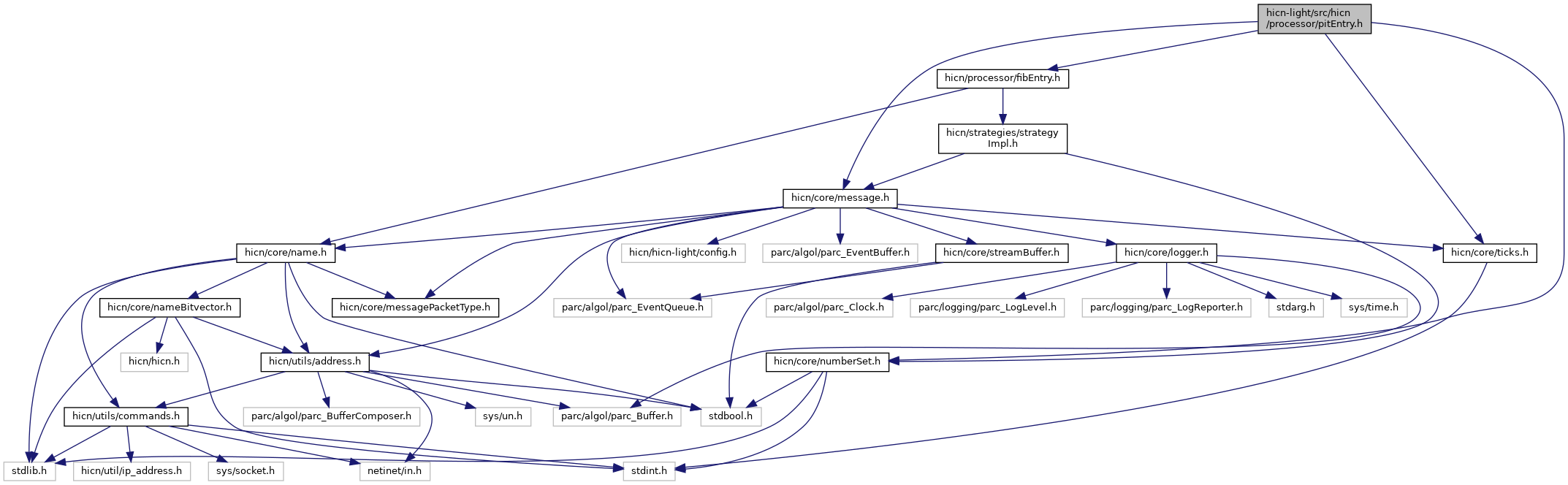
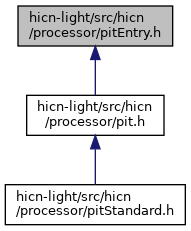
Go to the source code of this file.
Typedefs | |
| typedef struct pit_entry | PitEntry |
Functions | |
| PitEntry * | pitEntry_Create (Message *message, Ticks expiryTime, Ticks CreationTime) |
| void | pitEntry_Release (PitEntry **pitEntryPtr) |
| PitEntry * | pitEntry_Acquire (PitEntry *original) |
| void | pitEntry_AddIngressId (PitEntry *pitEntry, unsigned ingressId) |
| void | pitEntry_AddEgressId (PitEntry *pitEntry, unsigned egressId) |
| void | pitEntry_AddFibEntry (PitEntry *pitEntry, FibEntry *fibEntry) |
| FibEntry * | pitEntry_GetFibEntry (PitEntry *pitEntry) |
| const NumberSet * | pitEntry_GetIngressSet (const PitEntry *pitEntry) |
| const NumberSet * | pitEntry_GetEgressSet (const PitEntry *pitEntry) |
| Message * | pitEntry_GetMessage (const PitEntry *pitEntry) |
| Ticks | pitEntry_GetExpiryTime (const PitEntry *pitEntry) |
| Ticks | pitEntry_GetCreationTime (const PitEntry *pitEntry) |
| void | pitEntry_SetExpiryTime (PitEntry *pitEntry, Ticks expiryTime) |
Detailed Description
The embodiment of a PIT entry.
Embodies a PIT entry
Function Documentation
◆ pitEntry_Acquire()
| PitEntry* pitEntry_Acquire | ( | PitEntry * | original | ) |
@function pitEntry_Acquire @abstract Returns a reference counted copy @discussion A reference counted copy that shares the same state as the original. Caller must use pitEntry_Release() on it when done.
- Returns
- A reference counted copy, use Destroy on it.
◆ pitEntry_AddEgressId()
| void pitEntry_AddEgressId | ( | PitEntry * | pitEntry, |
| unsigned | egressId | ||
| ) |
@function pitEntry_AddEgressId @abstract Add an egress connection id to the list of attempted paths @discussion A PitEntry has two NumberSets. The first is the set of ingress ports, which make up the reverse path. The second is the set of egress ports, which make up its forward path.
This function tracks which forward paths we've tried for the interest.
- Parameters
-
egressId the forwarded path
◆ pitEntry_AddIngressId()
| void pitEntry_AddIngressId | ( | PitEntry * | pitEntry, |
| unsigned | ingressId | ||
| ) |
@function pitEntry_AddIngressId @abstract Add an ingress connection id to the list of reverse paths @discussion A PitEntry has two NumberSets. The first is the set of ingress ports, which make up the reverse path. The second is the set of egress ports, which make up its forward path.
This function tracks which reverse paths have sent us the interest.
- Parameters
-
ingressId the reverse path
◆ pitEntry_Create()
| PitEntry* pitEntry_Create | ( | Message * | message, |
| Ticks | expiryTime, | ||
| Ticks | CreationTime | ||
| ) |
@function pitEntry_Create @abstract Takes ownership of the message inside the PitEntry @discussion When the PIT entry is destroyed, will call message_Release() on the message.
◆ pitEntry_GetEgressSet()
| const NumberSet* pitEntry_GetEgressSet | ( | const PitEntry * | pitEntry | ) |
@function pitEntry_GetEgressSet @abstract The Egress connection id set @discussion You must acquire a copy of the number set if you will store the result. This is the internal reference.
- Parameters
-
< param1::>
- Returns
- May be empty, will not be null. Must be destroyed.
◆ pitEntry_GetExpiryTime()
| Ticks pitEntry_GetExpiryTime | ( | const PitEntry * | pitEntry | ) |
Returns the time (in ticks) at which the PIT entry is no longer valid
The ExpiryTime is computed when the PIT entry is added (or via pitEntry_SetExpiryTime). It is the aboslute time (in Ticks) at which the Pit entry is no longer valid.
- Parameters
-
[in] PitEntry An allocated PIT entry
- Return values
-
number The abosolute time (in Ticks) of the Expiry
◆ pitEntry_GetIngressSet()
| const NumberSet* pitEntry_GetIngressSet | ( | const PitEntry * | pitEntry | ) |
@function pitEntry_GetIngressSet @abstract The Ingress connection id set @discussion You must acquire a copy of the number set if you will store the result. This is the internal reference.
- Returns
- May be empty, will not be null. Must be destroyed.
◆ pitEntry_GetMessage()
| Message* pitEntry_GetMessage | ( | const PitEntry * | pitEntry | ) |
@function pitEntry_GetMessage @abstract Gets the interest underpinning the PIT entry @discussion A reference counted copy, call Message_Release() on it.
- Returns
- A reference counted copy, call
Message_Release()on it.
◆ pitEntry_Release()
| void pitEntry_Release | ( | PitEntry ** | pitEntryPtr | ) |
Release a previously acquired reference to the specified instance, decrementing the reference count for the instance.
The pointer to the instance is set to NULL as a side-effect of this function.
If the invocation causes the last reference to the instance to be released, the instance is deallocated and the instance's implementation will perform additional cleanup and release other privately held references.
- Parameters
-
[in,out] pitEntryPtr A pointer to a PitEntry instance pointer, which will be set to zero on return.
◆ pitEntry_SetExpiryTime()
| void pitEntry_SetExpiryTime | ( | PitEntry * | pitEntry, |
| Ticks | expiryTime | ||
| ) |
Sets the ExpriyTime of the PIT entry to the given value
It is probalby an error to set the expiryTime to a smaller value than currently set to, but this is not enforced. PIT entries use lazy delete.
- Parameters
-
[in] pitEntry The allocated PIT entry to modify [in] expiryTime The new expiryTime (UTC in forwarder Ticks)