A listener set is unique on (EncapType, localAddress) More...
#include <hicn/io/listener.h>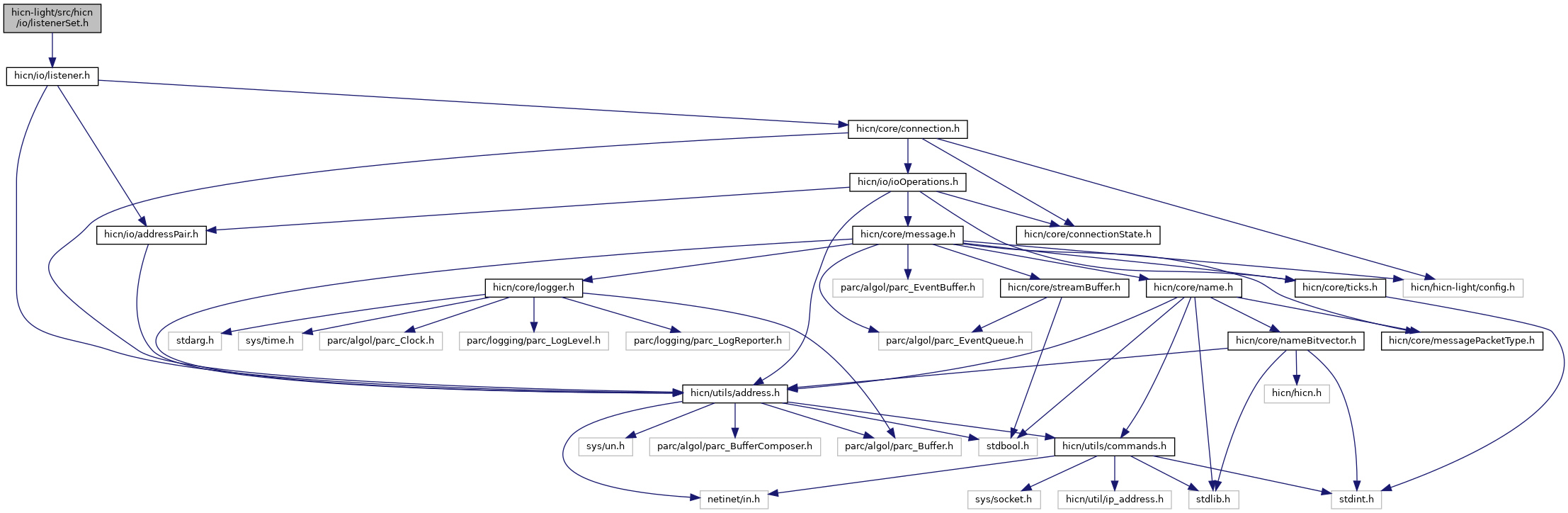

Go to the source code of this file.
Typedefs | |
| typedef struct listener_set | ListenerSet |
Functions | |
| ListenerSet * | listenerSet_Create (void) |
| void | listenerSet_Destroy (ListenerSet **setPtr) |
| bool | listenerSet_Add (ListenerSet *set, ListenerOps *ops) |
| size_t | listenerSet_Length (const ListenerSet *set) |
| ListenerOps * | listenerSet_Get (const ListenerSet *set, size_t index) |
| ListenerOps * | listenerSet_Find (const ListenerSet *set, EncapType encapType, const Address *localAddress) |
| ListenerOps * | listenerSet_FindById (const ListenerSet *set, unsigned id) |
| int | listenerSet_FindIdByListenerName (const ListenerSet *set, const char *listenerName) |
| void | listenerSet_RemoveById (const ListenerSet *set, unsigned id) |
Detailed Description
A listener set is unique on (EncapType, localAddress)
Keeps track of all the running listeners. The set is unique on the encapsulation type and the local address. For example, with TCP encapsulation and local address 127.0.0.1 or Ethernet encapsulation and MAC address 00:11:22:33:44:55.
NOTE: This does not allow multiple EtherType on the same interface because the Address for a LINK address does not include an EtherType.
Function Documentation
◆ listenerSet_Add()
| bool listenerSet_Add | ( | ListenerSet * | set, |
| ListenerOps * | ops | ||
| ) |
@function listenerSet_Add @abstract Adds the listener to the set @discussion Unique set based on pair (EncapType, localAddress). Takes ownership of the ops memory if added.
- Parameters
-
< param1::>
- Returns
- true if added, false if not
◆ listenerSet_Create()
| ListenerSet* listenerSet_Create | ( | void | ) |
<#One Line Description#>
<#Paragraphs Of Explanation#>
- Parameters
-
[< in out in,out#>] <#name#> <#description#>
- Return values
-
<::value::> <#explanation#>
Example:
◆ listenerSet_Destroy()
| void listenerSet_Destroy | ( | ListenerSet ** | setPtr | ) |
<#One Line Description#>
<#Paragraphs Of Explanation#>
- Parameters
-
[< in out in,out#>] <#name#> <#description#>
- Return values
-
<::value::> <#explanation#>
Example:
◆ listenerSet_Find()
| ListenerOps* listenerSet_Find | ( | const ListenerSet * | set, |
| EncapType | encapType, | ||
| const Address * | localAddress | ||
| ) |
Looks up a listener by its key (EncapType, LocalAddress)
<#Paragraphs Of Explanation#>
- Parameters
-
[in] set An allocated listener set [in] encapType the listener type [in] localAddress The local bind address (e.g. MAC address or TCP socket)
- Return values
-
non-null The listener matching the query null Does not exist
Example:
◆ listenerSet_FindById()
| ListenerOps* listenerSet_FindById | ( | const ListenerSet * | set, |
| unsigned | id | ||
| ) |
Looks up a listener by its id
<#Paragraphs Of Explanation#>
- Parameters
-
[in] set An allocated listener set [in] id of the listener
- Return values
-
non-null The listener matching the query null Does not exist
Example:
◆ listenerSet_FindIdByListenerName()
| int listenerSet_FindIdByListenerName | ( | const ListenerSet * | set, |
| const char * | listenerName | ||
| ) |
Looks up a listener by its id
<#Paragraphs Of Explanation#>
- Parameters
-
[in] set An allocated listener set [in] name of the listener
- Return values
-
greater or equal to 0 The listener matching the query -1 Does not exist
Example:
◆ listenerSet_Get()
| ListenerOps* listenerSet_Get | ( | const ListenerSet * | set, |
| size_t | index | ||
| ) |
Returns the listener at the given index
<#Paragraphs Of Explanation#>
- Parameters
-
[in] set An allocated listener set [in] index The index position (0 <= index < listenerSet_Lenght)
- Return values
-
non-null The listener at index null An error
Example:
◆ listenerSet_Length()
| size_t listenerSet_Length | ( | const ListenerSet * | set | ) |
The number of listeners in the set
<#Paragraphs Of Explanation#>
- Parameters
-
[in] set An allocated listener set
- Return values
-
<::value::> <#explanation#>
Example:
◆ listenerSet_RemoveById()
| void listenerSet_RemoveById | ( | const ListenerSet * | set, |
| unsigned | id | ||
| ) |
Remove up a listener by its id
<#Paragraphs Of Explanation#>
- Parameters
-
[in] set An allocated listener set [in] id of the listener
Example: