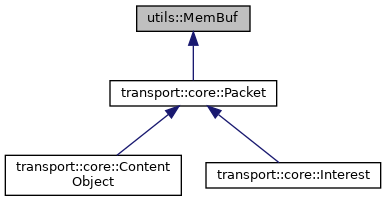
Public Types | |
| enum | CreateOp { CREATE } |
| enum | WrapBufferOp { WRAP_BUFFER } |
| enum | TakeOwnershipOp { TAKE_OWNERSHIP } |
| enum | CopyBufferOp { COPY_BUFFER } |
| using | Ptr = std::shared_ptr< MemBuf > |
| typedef void(* | FreeFunction) (void *buf, void *userData) |
Public Member Functions | |
| MemBuf (CreateOp, std::size_t capacity) | |
| MemBuf (TakeOwnershipOp op, void *buf, std::size_t capacity, FreeFunction freeFn=nullptr, void *userData=nullptr, bool freeOnError=true) | |
| MemBuf (TakeOwnershipOp, void *buf, std::size_t capacity, std::size_t length, FreeFunction freeFn=nullptr, void *userData=nullptr, bool freeOnError=true) | |
| MemBuf (WrapBufferOp op, const void *buf, std::size_t length, std::size_t capacity) noexcept | |
| MemBuf (CopyBufferOp op, const void *buf, std::size_t size, std::size_t headroom=0, std::size_t minTailroom=0) | |
| bool | empty () const |
| const uint8_t * | data () const |
| uint8_t * | writableData () |
| const uint8_t * | tail () const |
| uint8_t * | writableTail () |
| std::size_t | length () const |
| void | setLength (std::size_t length) |
| std::size_t | headroom () const |
| std::size_t | tailroom () const |
| const uint8_t * | buffer () const |
| uint8_t * | writableBuffer () |
| const uint8_t * | bufferEnd () const |
| std::size_t | capacity () const |
| MemBuf * | next () |
| const MemBuf * | next () const |
| MemBuf * | prev () |
| const MemBuf * | prev () const |
| void | advance (std::size_t amount) |
| void | retreat (std::size_t amount) |
| void | prepend (std::size_t amount) |
| void | append (std::size_t amount) |
| void | trimStart (std::size_t amount) |
| void | trimEnd (std::size_t amount) |
| void | clear () |
| void | reserve (std::size_t minHeadroom, std::size_t minTailroom) |
| bool | isChained () const |
| size_t | countChainElements () const |
| std::size_t | computeChainDataLength () const |
| void | prependChain (std::unique_ptr< MemBuf > &&iobuf) |
| void | appendChain (std::unique_ptr< MemBuf > &&iobuf) |
| std::unique_ptr< MemBuf > | unlink () |
| std::unique_ptr< MemBuf > | pop () |
| std::unique_ptr< MemBuf > | separateChain (MemBuf *head, MemBuf *tail) |
| bool | isShared () const |
| bool | isManaged () const |
| bool | isManagedOne () const |
| bool | isSharedOne () const |
| void | unshare () |
| void | unshareOne () |
| void | markExternallyShared () |
| void | markExternallySharedOne () |
| void | makeManaged () |
| void | makeManagedOne () |
| void | gather (std::size_t maxLength) |
| std::unique_ptr< MemBuf > | clone () const |
| MemBuf | cloneAsValue () const |
| std::unique_ptr< MemBuf > | cloneOne () const |
| MemBuf | cloneOneAsValue () const |
| std::unique_ptr< MemBuf > | cloneCoalesced () const |
| std::unique_ptr< MemBuf > | cloneCoalescedWithHeadroomTailroom (std::size_t newHeadroom, std::size_t newTailroom) const |
| MemBuf | cloneCoalescedAsValue () const |
| MemBuf | cloneCoalescedAsValueWithHeadroomTailroom (std::size_t newHeadroom, std::size_t newTailroom) const |
| void | cloneInto (MemBuf &other) const |
| void | cloneOneInto (MemBuf &other) const |
| std::vector< struct iovec > | getIov () const |
| void | appendToIov (std::vector< struct iovec > *iov) const |
| size_t | fillIov (struct iovec *iov, size_t len) const |
| bool | ensureCapacity (std::size_t capacity) |
| bool | ensureCapacityAndFillUnused (std::size_t capacity, uint8_t placeholder) |
| void * | operator new (size_t size) |
| void * | operator new (size_t size, void *ptr) |
| void | operator delete (void *ptr) |
| void | operator delete (void *ptr, void *placement) |
| bool | operator== (const MemBuf &other) |
| bool | operator!= (const MemBuf &other) |
| MemBuf () noexcept | |
| MemBuf (MemBuf &&other) noexcept | |
| MemBuf & | operator= (MemBuf &&other) noexcept |
| MemBuf (const MemBuf &other) | |
| MemBuf & | operator= (const MemBuf &other) |
Static Public Member Functions | |
| static std::unique_ptr< MemBuf > | create (std::size_t capacity) |
| static std::unique_ptr< MemBuf > | createCombined (std::size_t capacity) |
| static std::unique_ptr< MemBuf > | createSeparate (std::size_t capacity) |
| static std::unique_ptr< MemBuf > | createChain (size_t totalCapacity, std::size_t maxBufCapacity) |
| static std::unique_ptr< MemBuf > | takeOwnership (void *buf, std::size_t capacity, FreeFunction freeFn=nullptr, void *userData=nullptr, bool freeOnError=true) |
| static std::unique_ptr< MemBuf > | takeOwnership (void *buf, std::size_t capacity, std::size_t length, FreeFunction freeFn=nullptr, void *userData=nullptr, bool freeOnError=true) |
| static std::unique_ptr< MemBuf > | wrapBuffer (const void *buf, std::size_t length, std::size_t capacity) |
| static MemBuf | wrapBufferAsValue (const void *buf, std::size_t length, std::size_t capacity) noexcept |
| static std::unique_ptr< MemBuf > | copyBuffer (const void *buf, std::size_t size, std::size_t headroom=0, std::size_t minTailroom=0) |
| static void | destroy (std::unique_ptr< MemBuf > &&data) |
| static std::unique_ptr< MemBuf > | wrapIov (const iovec *vec, size_t count) |
| static std::unique_ptr< MemBuf > | takeOwnershipIov (const iovec *vec, size_t count, FreeFunction freeFn=nullptr, void *userData=nullptr, bool freeOnError=true) |
Constructor & Destructor Documentation
◆ MemBuf() [1/2]
|
noexcept |
◆ MemBuf() [2/2]
|
noexcept |
Move constructor and assignment operator.
In general, you should only ever move the head of an MemBuf chain. Internal nodes in an MemBuf chain are owned by the head of the chain, and should not be moved from. (Technically, nothing prevents you from moving a non-head node, but the moved-to node will replace the moved-from node in the chain. This has implications for ownership, since non-head nodes are owned by the chain head. You are then responsible for relinquishing ownership of the moved-to node, and manually deleting the moved-from node.)
With the move assignment operator, the destination of the move should be the head of an MemBuf chain or a solitary MemBuf not part of a chain. If the move destination is part of a chain, all other MemBufs in the chain will be deleted.
Member Function Documentation
◆ advance()
|
inline |
Shift the data forwards in the buffer.
This shifts the data pointer forwards in the buffer to increase the headroom. This is commonly used to increase the headroom in a newly allocated buffer.
The caller is responsible for ensuring that there is sufficient tailroom in the buffer before calling advance().
If there is a non-zero data length, advance() will use memmove() to shift the data forwards in the buffer. In this case, the caller is responsible for making sure the buffer is unshared, so it will not affect other MemBufs that may be sharing the same underlying buffer.
◆ appendToIov()
| void utils::MemBuf::appendToIov | ( | std::vector< struct iovec > * | iov | ) | const |
Update an existing iovec array with the MemBuf data.
New iovecs will be appended to the existing vector; anything already present in the vector will be left unchanged.
Naturally, the returned iovec data will be invalid if you modify the buffer chain.
◆ clone()
| std::unique_ptr<MemBuf> utils::MemBuf::clone | ( | ) | const |
◆ cloneAsValue()
| MemBuf utils::MemBuf::cloneAsValue | ( | ) | const |
◆ cloneCoalesced()
| std::unique_ptr<MemBuf> utils::MemBuf::cloneCoalesced | ( | ) | const |
Return a new unchained MemBuf that may share the same data as this chain.
If the MemBuf chain is not chained then the new MemBuf will point to the same underlying data buffer as the original chain. Otherwise, it will clone and coalesce the MemBuf chain.
The new MemBuf will have at least as much headroom as the first MemBuf in the chain, and at least as much tailroom as the last MemBuf in the chain.
Throws std::bad_alloc on error.
◆ cloneCoalescedAsValue()
| MemBuf utils::MemBuf::cloneCoalescedAsValue | ( | ) | const |
Similar to cloneCoalesced(). But returns MemBuf by value rather than heap-allocating it.
◆ cloneCoalescedAsValueWithHeadroomTailroom()
| MemBuf utils::MemBuf::cloneCoalescedAsValueWithHeadroomTailroom | ( | std::size_t | newHeadroom, |
| std::size_t | newTailroom | ||
| ) | const |
This is similar to the cloneCoalescedAsValue() method, except this allows to set a headroom and tailroom for the new MemBuf.
◆ cloneCoalescedWithHeadroomTailroom()
| std::unique_ptr<MemBuf> utils::MemBuf::cloneCoalescedWithHeadroomTailroom | ( | std::size_t | newHeadroom, |
| std::size_t | newTailroom | ||
| ) | const |
This is similar to the cloneCoalesced() method, except this allows to set a headroom and tailroom for the new MemBuf.
◆ cloneInto()
|
inline |
Similar to Clone(). But use other as the head node. Other nodes in the chain (if any) will be allocted on heap.
◆ cloneOne()
| std::unique_ptr<MemBuf> utils::MemBuf::cloneOne | ( | ) | const |
◆ cloneOneAsValue()
| MemBuf utils::MemBuf::cloneOneAsValue | ( | ) | const |
Similar to cloneOne(). But returns MemBuf by value rather than heap-allocating it.
◆ cloneOneInto()
|
inline |
◆ copyBuffer()
|
inlinestatic |
Convenience function to create a new MemBuf object that copies data from a user-supplied buffer, optionally allocating a given amount of headroom and tailroom.
◆ createChain()
|
static |
Allocate a new MemBuf chain with the requested total capacity, allocating no more than maxBufCapacity to each buffer.
◆ createCombined()
|
static |
Create a new MemBuf, using a single memory allocation to allocate space for both the MemBuf object and the data storage space.
This saves one memory allocation. However, it can be wasteful if you later need to grow the buffer using reserve(). If the buffer needs to be reallocated, the space originally allocated will not be freed() until the MemBuf object itself is also freed. (It can also be slightly wasteful in some cases where you clone this MemBuf and then free the original MemBuf.)
◆ createSeparate()
|
static |
Create a new IOBuf, using separate memory allocations for the IOBuf object for the IOBuf and the data storage space.
This requires two memory allocations, but saves space in the long run if you know that you will need to reallocate the data buffer later.
◆ destroy()
|
inlinestatic |
Convenience function to free a chain of MemBufs held by a unique_ptr.
◆ ensureCapacity()
| bool utils::MemBuf::ensureCapacity | ( | std::size_t | capacity | ) |
Ensure the current MemBuf can hold at least capacity bytes and its memory is contiguous
◆ ensureCapacityAndFillUnused()
| bool utils::MemBuf::ensureCapacityAndFillUnused | ( | std::size_t | capacity, |
| uint8_t | placeholder | ||
| ) |
Ensure packet buffer can hold at least 1500 bytes in contiguous memory and fill unused memory with placeholder
◆ fillIov()
| size_t utils::MemBuf::fillIov | ( | struct iovec * | iov, |
| size_t | len | ||
| ) | const |
Fill an iovec array with the MemBuf data.
Returns the number of iovec filled. If there are more buffer than iovec, returns 0. This version is suitable to use with stack iovec arrays.
Naturally, the filled iovec data will be invalid if you modify the buffer chain.
◆ gather()
|
inline |
Ensure that this chain has at least maxLength bytes available as a contiguous memory range.
This method coalesces whole buffers in the chain into this buffer as necessary until this buffer's length() is at least maxLength.
After coalescing, the MemBuf will have at least as much headroom as the first MemBuf in the chain, and at least as much tailroom as the last MemBuf that was coalesced.
Throws std::bad_alloc or std::overflow_error on error. On error the MemBuf chain will be unmodified. Throws std::overflow_error if maxLength is longer than the total chain length.
Upon return, either enough of the chain was coalesced into a contiguous region, or the entire chain was coalesced. That is, length() >= maxLength || !isChained() is true.
◆ getIov()
| std::vector<struct iovec> utils::MemBuf::getIov | ( | ) | const |
Return an iovector suitable for e.g. writev()
auto iov = buf->getIov(); auto xfer = writev(fd, iov.data(), iov.size());
Naturally, the returned iovector is invalid if you modify the buffer chain.
◆ isManaged()
|
inline |
Return true if all MemBufs in this chain are managed by the usual refcounting mechanism (and so the lifetime of the underlying memory can be extended by clone()).
◆ isManagedOne()
|
inline |
Return true if this MemBuf is managed by the usual refcounting mechanism (and so the lifetime of the underlying memory can be extended by cloneOne()).
◆ isShared()
|
inline |
Return true if at least one of the MemBufs in this chain are shared, or false if all of the MemBufs point to unique buffers.
Use isSharedOne() to only check this MemBuf rather than the entire chain.
◆ isSharedOne()
|
inline |
Return true if other MemBufs are also pointing to the buffer used by this MemBuf, and false otherwise.
If this MemBuf points at a buffer owned by another (non-MemBuf) part of the code (i.e., if the MemBuf was created using wrapBuffer(), or was cloned from such an MemBuf), it is always considered shared.
This only checks the current MemBuf, and not other MemBufs in the chain.
◆ makeManaged()
|
inline |
Ensure that the memory that MemBufs in this chain refer to will continue to be allocated for as long as the MemBufs of the chain (or any clone()s created from this point onwards) is alive.
This only has an effect for user-owned buffers (created with the WRAP_BUFFER constructor or wrapBuffer factory function), in which case those buffers are unshared.
◆ makeManagedOne()
|
inline |
Ensure that the memory that this MemBuf refers to will continue to be allocated for as long as this MemBuf (or any clone()s created from this point onwards) is alive.
This only has an effect for user-owned buffers (created with the WRAP_BUFFER constructor or wrapBuffer factory function), in which case those buffers are unshared.
◆ markExternallyShared()
| void utils::MemBuf::markExternallyShared | ( | ) |
Mark the underlying buffers in this chain as shared with external memory management mechanism. This will make isShared() always returns true.
This function is not thread-safe, and only safe to call immediately after creating an MemBuf, before it has been shared with other threads.
◆ markExternallySharedOne()
|
inline |
Mark the underlying buffer that this MemBuf refers to as shared with external memory management mechanism. This will make isSharedOne() always returns true.
This function is not thread-safe, and only safe to call immediately after creating an MemBuf, before it has been shared with other threads.
◆ operator==()
| bool utils::MemBuf::operator== | ( | const MemBuf & | other | ) |
Override operator == and !=
◆ pop()
|
inline |
◆ retreat()
|
inline |
Shift the data backwards in the buffer.
The caller is responsible for ensuring that there is sufficient headroom in the buffer before calling retreat().
If there is a non-zero data length, retreat() will use memmove() to shift the data backwards in the buffer. In this case, the caller is responsible for making sure the buffer is unshared, so it will not affect other MemBufs that may be sharing the same underlying buffer.
◆ separateChain()
Remove a subchain from this chain.
Remove the subchain starting at head and ending at tail from this chain.
Returns a unique_ptr pointing to head. (In other words, ownership of the head of the subchain is transferred to the caller.) If the caller ignores the return value and lets the unique_ptr be destroyed, the subchain will be immediately destroyed.
The subchain referenced by the specified head and tail must be part of the same chain as the current MemBuf, but must not contain the current MemBuf. However, the specified head and tail may be equal to each other (i.e., they may be a subchain of length 1).
◆ takeOwnershipIov()
|
static |
A helper that takes ownerships a number of iovecs into an MemBuf chain. If count == 0, then a zero length buf is returned. This function never returns nullptr.
◆ unshare()
|
inline |
Ensure that this MemBuf has a unique buffer that is not shared by other MemBufs.
unshare() operates on an entire chain of MemBuf objects. If the chain is shared, it may also coalesce the chain when making it unique. If the chain is coalesced, subsequent MemBuf objects in the current chain will be automatically deleted.
Note that buffers owned by other (non-MemBuf) users are automatically considered shared.
Throws std::bad_alloc on error. On error the MemBuf chain will be unmodified.
Currently unshare may also throw std::overflow_error if it tries to coalesce. (TODO: In the future it would be nice if unshare() were smart enough not to coalesce the entire buffer if the data is too large. However, in practice this seems unlikely to become an issue.)
◆ unshareOne()
|
inline |
Ensure that this MemBuf has a unique buffer that is not shared by other MemBufs.
unshareOne() operates on a single MemBuf object. This MemBuf will have a unique buffer after unshareOne() returns, but other MemBufs in the chain may still be shared after unshareOne() returns.
Throws std::bad_alloc on error. On error the MemBuf will be unmodified.
◆ wrapIov()
A helper that wraps a number of iovecs into an MemBuf chain. If count == 0, then a zero length buf is returned. This function never returns nullptr.
The documentation for this class was generated from the following file:
- libtransport/includes/hicn/transport/utils/membuf.h